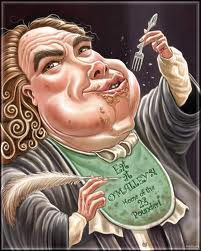
 In "A Modest Proposal," Jonathan Swift assumes a persona (false personal voice as a writer) and suggests an outrageous course of action. In most of the essay, he does not mean what he says. The proposal is morally abhorrant to the real Swift. Why do you think he writes his "Modest Proposal" rather than saying directly what he believes? What are the advantages (and/or disadvantages) of saying the opposite of what he thinks? Find evidence in the essay that Swift does not want us to take him seriously.
Wednesday, November 16, 2011
Question for November 18: A Modest Proposal (pp. 2462-68)
In "A Modest Proposal," Jonathan Swift assumes a persona (false personal voice as a writer) and suggests an outrageous course of action. In most of the essay, he does not mean what he says. The proposal is morally abhorrant to the real Swift. Why do you think he writes his "Modest Proposal" rather than saying directly what he believes? What are the advantages (and/or disadvantages) of saying the opposite of what he thinks? Find evidence in the essay that Swift does not want us to take him seriously.
Tuesday, November 15, 2011
Question for November 16: The Way of the World, Act 5

Saturday, November 12, 2011
Question for November 14: Acts 3-4, The Way of the World

Thursday, November 10, 2011
Question for November 11: The Way of the World, Acts 1 and 2
The hero of "The Way of the World" is Mirabell. He is a character whose "heroism" made perfect sense to 18th century audiences, but modern audiences tend to have trouble, at first, viewing him as the hero of the story. Examine the character of Mirabell as he is presented in Acts 1 and 2 (pp. 2228-48). The last three paragraphs of the introduction, pages 2227-28, will be helpful in explaining the characters and their relationships. What relationships with women has Mirabell had in the past? Whom does he want to marry? What admirable (or disturbing) actions has he done in the past? Discuss Mirabell actions and passions and decide whether or not you find him heroic thus far.
Saturday, November 5, 2011
Question for November 7: Paradise Lost, Book 9

Consider either Satan, Adam and Eve. How does this character rationalize his or her behavior in Book 9?
Wednesday, November 2, 2011
Question for November 4: Paradise Lost, Book 4

Tuesday, November 1, 2011
Question for November 2: Paradise Lost, Book 1

Subscribe to:
Posts (Atom)